The Deep-End Dynamic
Why some markets rise as creators drown

Writers already have a difficult time accounting for the hours they commit just to writing their books—let alone assigning real value to that time.
Long before a manuscript becomes a product, thousands of invisible decisions have already been made: evenings surrendered, weekends consumed, creative energy rationed against paid work, family, and rest. Most writers underestimate this cost, not because they are careless, but because the culture around writing encourages us to treat time as passion rather than labour.
What we are seeing now—particularly in indie publishing, but increasingly across creative markets—is something more dangerous than simple undervaluation. It is a pattern. A structure.
I’ve come to call it the deep-end dynamic.
The Jump
The deep-end dynamic begins with commitment.
An author decides to go indie. To self-publish. To “take control.” The jump into the deep end is intentional and often empowering. You know it will be hard. You know there is risk. But you jump anyway because the alternative—waiting for permission, waiting for validation—feels worse.
At first, everything feels like motion. Uploads. Formatting. Pricing experiments. Marketing tweaks. New platforms. New tools. New advice. Every action feels like progress because you are moving.
But this is where the dynamic turns.
Instead of doing what is required to stay afloat—establishing sustainable pricing, setting boundaries, protecting time and energy—many creators begin to swim deeper. They mistake depth for progress and motion for momentum.
And in doing so, they quietly cut off their own air supply.
The Deep-End Dynamic (Definition)
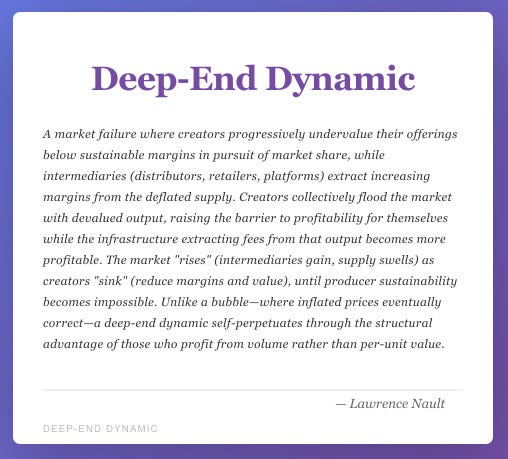
Deep-End Dynamic (noun):
A market failure in which creators progressively undervalue their work below sustainable margins in pursuit of visibility or market share, while intermediaries—platforms, distributors, and retailers—extract increasing profit from the resulting volume.
As creators flood the market with devalued output, the threshold for profitability rises, sustainability collapses, and the infrastructure profiting from per-unit transactions becomes more lucrative. The market “rises” as creators “sink.”
Unlike a bubble, which corrects when inflated prices collapse, the deep-end dynamic self-perpetuates through structural incentives that reward volume over value.
Swimming Deeper While Losing Oxygen
In indie publishing, this pattern shows up in familiar ways:
Prices are lowered to “stay competitive.”
Margins are absorbed rather than challenged.
New platform costs are quietly internalized.
Output increases to compensate for declining returns.
Time is treated as flexible, renewable, or free.
Indie authors often point out—correctly—that there is no aspect of book production, distribution, or retail they can’t do themselves. Editing, formatting, cover design, print setup, distribution logistics, direct sales infrastructure—none of it is inaccessible.
But capability is not sustainability.
When authors perform every role without pricing their labour into the equation, they are not building resilience. They are subsidizing the system with their own oxygen.
At a certain point, the math becomes unavoidable: if you are paying yourself nothing for your time, if margins collapse under platform fees and discounting pressure, then burning the cash outright would take less effort than doing all this work and getting nothing for it.
The Water Rises
As creators swim deeper, the water rises.
Platforms and intermediaries profit from volume, not from creator survival. Their margins are extracted per transaction, per unit moved, per interaction logged.
Amazon does not care whether an indie book is priced at $0.99 or $9.99. They take their cut either way. In many cases, lower prices increase velocity. More units move. More transactions occur. Platform revenue grows.
The market rises on creator mass.
As more underpriced work floods the system, discoverability erodes, competition intensifies, and the threshold for profitability moves further out of reach. Meanwhile, the infrastructure skimming from every transaction becomes more profitable precisely because of that flood.
This is why the deep-end dynamic is not a bubble.
Bubbles burst.
The deep-end dynamic stabilizes around exhaustion.
Creators sink.
Intermediaries float.
Not Everyone Loses—Some Win by Design
It is tempting to say that everyone loses in these systems. That the market is broken for all participants.
That is not true.
Some actors win by design.
The deep-end dynamic is a parasitic market failure: intermediaries extract increasing value from creator desperation while remaining insulated from creator collapse. Risk is externalized downward. Volume is rewarded upward.
The water does not rise accidentally.
It rises because the system is built to climb on mass.
Beyond Publishing
Once seen, the deep-end dynamic appears everywhere.
On social media, creators are pushed to post more as reach declines. Algorithms reward velocity, consistency, and engagement volume—not sustainability. Platforms monetize attention regardless of burnout.
In the broader creative economy, exposure replaces pay. Speed replaces craft. Platforms profit from throughput while creators absorb overhead.
Different markets. Same water.
AI as an Accelerator
Artificial intelligence did not create the deep-end dynamic.
It accelerates it.
AI lowers the marginal cost of output, removing friction from supply. Platforms benefit from scale. Human creators—who still require time, rest, and income—are pushed into steeper competition with collapsing margins.
This is not because AI is malicious.
It is because existing structures already reward volume over value.
The water rises faster.
Staying Afloat
Resisting the deep-end dynamic does not mean refusing markets. It means refusing the illusion that motion equals survival.
Staying afloat looks like:
Treating time as a priced input.
Resisting reflexive price cuts.
Reducing output instead of increasing it.
Choosing where not to compete.
Designing for longevity rather than visibility spikes.
Opting out of the deep end is not quitting.
It is choosing not to drown.
Naming the Water
The value of naming the deep-end dynamic is not rhetorical—it is practical.
When creators recognize that the pressure they feel is structural, not personal, they can stop blaming themselves for not swimming fast enough and start questioning the depth they are being pushed into.
The water rising is not opportunity.
It is wealth transfer.
And until we name it, the system will continue to reward those who never need to breathe—while asking creators to swim just a little deeper.