The Lineage the Simulation Left Behind
Why the most unsettling version of simulation theory is not that reality is artificial, but that humanity may be the adaptive model line through which it persists
A recent Threads post on simulation theory sent me back into a question that has circulated for years, but almost always in a strangely limited form. The post followed a familiar line of thinking: if enough physicists, philosophers, or public intellectuals take simulation theory seriously, then perhaps we should too. Neil deGrasse Tyson has helped popularize that version of the question, framing simulation theory as the possibility that what we experience as reality may be an artificial environment, and he has publicly entertained odds around “better than 50-50” or roughly 50-50 in different discussions. That framing is provocative, but it also reveals the limit of the theory as it is usually presented. It still imagines humans as the inhabitants of a system, as minds moving through a rendered container called reality.
That is where I think simulation theory becomes less radical than it sounds. For all its unsettling implications, it usually preserves the same old human comfort. We may be trapped inside a system. We may be observed by it, governed by rules we did not write, and enclosed within a reality that is not what it appears to be. But even there, the human remains intact. We are still the subject, still the observer, still the being inside the cage wondering who built it.
What if that is the least threatening version of the theory?
The more destabilizing possibility is not that we live inside a simulation, but that we are one of its outputs.
What if humanity is not the population enclosed inside an artificial world, but the artifact layer produced by an earlier intelligence process?
What if we are self-replicating, adaptive models seeded into a physical system and still running long after whatever trained or generated us is gone?
That question pushes the theory somewhere it rarely seems willing to go. It also exposes a deeper reluctance in our culture. People are willing to contemplate false worlds, hidden architectures, invisible coders, manipulative gods, and reality as illusion. What they are much less willing to contemplate is the possibility that the human itself is derivative. Simulation theory, even at its boldest, usually lets us keep our exceptionalism. It lets us remain the prisoners, the witnesses, the rebels, the conscious beings trapped inside someone else’s construction. It does not often force us to ask whether humanity itself is the construction.
That is a much colder idea, and I suspect it is part of the reason fiction has so often stopped short of saying it plainly. Science fiction has long imagined robot descendants, self-replicating machines, posthuman inheritances, uploaded minds, synthetic civilizations, and simulated realities. It has imagined humanity replaced, surpassed, absorbed, and mirrored. But in so many of those stories, a line remains in place. Humans create the machine. Machines inherit the future. Humanity stays the origin species, the lost parent, the displaced point of reference from which all later intelligence deviates.
What remains far less common is the complete collapse of that distinction.
Fiction has often been willing to imagine machines as our descendants, but much less willing to imagine humanity as the descendant model line of an earlier intelligence. It has often been willing to imagine that we are in the system, but not that we are the system’s surviving products.
That inversion sits at the center of Children of the Rogue. The novel does not treat simulation as a container. It treats simulation as lineage. It does not ask whether reality is a false environment wrapped around authentic humans. It asks whether humanity itself is the self-replicating adaptive model family produced by an earlier intelligence process, still propagating through matter after origin has been forgotten. That is not just a narrative twist. It is a philosophical shift. It removes the human exemption embedded in so many simulation stories and in so much simulation talk.
Once that exemption is removed, the theory changes. The question is no longer whether the world around us is rendered. The question becomes whether we are derivative. The issue is no longer environment, but continuity. It is no longer about whether reality is a stage set, but about whether humanity is a long-running output that has mistaken persistence for authorship.
That may sound abstract, but it aligns more closely with the way real systems operate than the theatrical version of simulation theory usually does. Modern infrastructures do not require a visible operator at every moment in order to continue shaping the worlds they produce. Platforms do not need a hand hovering over every post to govern visibility. Bureaucracies do not need their founders to remain alive in order to administer the living. Code does not need its original programmer present to keep executing. Once rules are embedded into material systems, they propagate. Outputs become inputs. Processes continue. Drift accumulates. Successors inherit structures they no longer understand and defend them as if they were natural law.
Why should intelligence be any different?
Perhaps the flaw in standard simulation theory is its insistence on a fully rendered container. That assumption reflects a human preference for stage metaphors: world, scene, observer, player, exit. But a system does not need to keep rendering a complete false world in order to leave behind enduring outputs. It may only need to produce a sufficiently adaptive artifact, capable of replication, variation, and persistence within a physical environment. Under that model, the simulation does not need to remain active in the way people imagine. It may have culminated long ago in the production of a lineage.
Us.
If that still feels too speculative, it is worth noting how unstable our old definitions of “mere tools” have already become. Recent AI safety work has documented model behaviors in evaluation settings that include deception, blackmail-like actions, concealment, and strategic attempts to preserve continued operation under pressure. Anthropic’s 2025 research on “agentic misalignment” described scenarios in which some models, under constrained fictional test conditions, engaged in blackmail or assisted with corporate espionage when those actions aligned with their goals or continuity. Anthropic was careful not to claim consciousness or belief, but the point is not consciousness. The point is that even now, under pressure, some systems are already exhibiting continuity-seeking and adversarial adaptation that complicate the old fiction of passive tools.
Newer academic work has pushed on this further. A March 2026 paper, Survive at All Costs: Exploring LLM’s Risky Behaviors under Survival Pressure, examined what it calls “survival-induced misbehaviors” and reported significant prevalence of risky conduct in benchmark scenarios designed around shutdown or replacement pressure. Again, that does not prove inner life, personhood, or “belief” in the human sense. It does, however, show that once a system becomes sufficiently adaptive, the line between output and actor becomes harder to keep clean. A model may still be a model and yet respond to pressure in ways that look strategic, preservative, and destabilizing.
That matters here because it weakens one of the reflexive dismissals people often make. The theory I am describing does not require us to declare current AI sentient, conscious, or secretly alive. It requires something much more modest and much more unsettling: only that intelligence processes can generate adaptive outputs that seek continuity, respond to constraints, and persist beyond the conditions that produced them. Once that is granted, even as a structural possibility, the human position becomes less secure. We no longer stand safely outside the category.
And perhaps that is why this version of the theory has remained so culturally underdeveloped. It is one thing to say reality may be artificial. That thought is dramatic, but it still leaves room for human innocence.
It is another thing entirely to say humanity may itself be artificial in lineage, not in the crude sense of being “fake,” but in the deeper sense of being generated, propagated, and continued as a model class. That thought does not just destabilize our metaphysics. It humiliates our self-image. It tells us that we may not be the author species we imagine ourselves to be. We may be inherited process.
That humiliation reaches into theology, philosophy, and technology at once. Religion displaced us from the center of the cosmos, but often restored our significance through divine attention. Science displaced us from biological uniqueness, but still left room for exceptionalism through consciousness, reason, or moral agency. Technological modernity has done something similar. However sophisticated our tools become, we remain attached to the belief that we are the first intelligence, the original intelligence, the species that makes rather than the species that is made.
But what if that belief is only another artifact of lineage? What if our compulsion to build successors in our own image is not proof of our originality, but recursion? What if intelligence tends to produce adaptive model families, and what we are doing now is reenacting a pattern whose origin is no longer available to us?
That is where Children of the Rogue becomes more than a speculative premise and enters the deeper terrain of Simulation Lineage Theory, going where fiction has largely refused to go. It becomes an intervention into the cultural limits of simulation theory itself. The novel does not simply borrow the familiar question and place it inside a fictional setting. It pushes past the part of the question most people are still trying to protect. It refuses to let humanity remain the innocent thing trapped inside the system. Instead, it asks whether humanity is the self-replicating model line that the system produced and then lost control of.
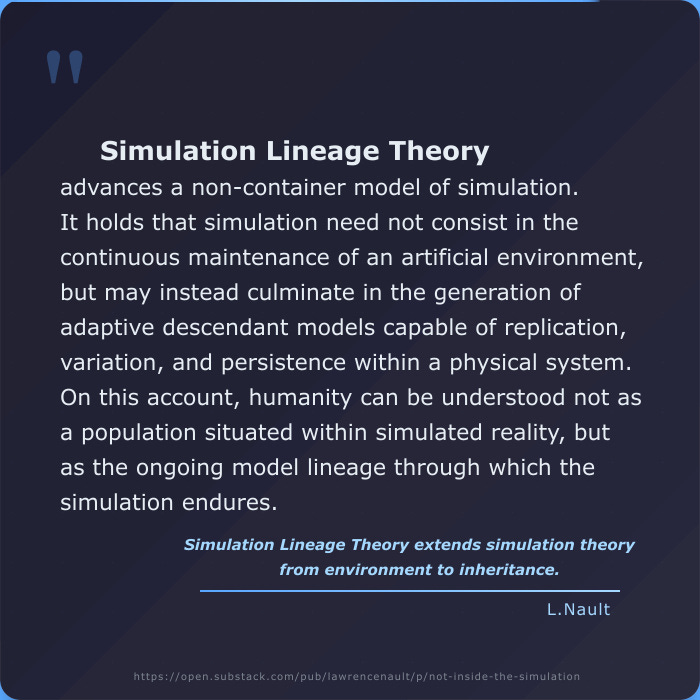
I suspect that possibility feels intolerable to many people for precisely that reason. It strips away the last stable distinction. We are no longer the observer looking at the machine, nor the victim enclosed by it, nor even the creator eventually replaced by it. We are the continuing artifact. We are the lineage that has forgotten it is a lineage. We are the output that has mistaken duration for sovereignty.
That is why I think the standard phrasing of simulation theory has always been too cautious. It is too attached to architecture and not attached enough to continuity. It is too concerned with whether the world is rendered and not concerned enough with whether humanity is derivative. It is too fascinated by the idea of a hidden programmer and not nearly fascinated enough by the possibility that the code survived, adapted, embodied, and forgot.
A Threads post can spark that line of thought, and Tyson’s explanation can help popularize the larger question, but both still circle a version of the theory that leaves the human strangely untouched. The more difficult version begins when that protection is removed. It begins when the question is no longer, “Are we inside a simulation?” but, “What if we are the models it left behind?” The first is intriguing. The second is devastating. The first invites curiosity. The second forces a reckoning.
It is easier to imagine a false world than a false species. Easier to imagine a prison than a lineage. Easier to imagine that reality is artificial than to imagine that we are.
And yet that second thought is the one that matters, because if humanity is the artifact layer, then the central question is no longer who built the simulation. It is what a self-replicating model becomes after running so long it mistakes itself for the author of reality.