Ghost Democracy
When protest becomes ritual, petitions become props, and your voice becomes background noise.
We spent the last few years watching the United States like it was a warning label. We criticized, condemned, and asked the question that always sounds easy from a safe distance: how did Americans let white Christian nationalist fascism take over—and why did so little stop it?
Now Alberta is answering that question in real time.
Not as spectators. As residents.
And the thing you don’t understand from the outside—until it’s happening to you—is that authoritarianism doesn’t always arrive as a single boot through a door. It arrives as a pace. A posture. A pattern. It arrives as a government that learns it can ignore you, then grows addicted to that feeling. It arrives while still wearing the mask of “normal,” while still calling itself “common sense,” while still pretending it’s “just politics.”
It isn’t “just politics” when you start feeling like your voice doesn’t count as human input anymore.
Even many of the people who were pleased they got the government they voted for didn’t expect this government. They didn’t vote for the authoritarian zealotry of Smith riding roughshod over rights like they’re optional. They didn’t vote for open contempt, for the gleeful cruelty, for the sense that there’s a private joke happening behind closed doors and the public is the punchline.
They didn’t vote for the moment you realize your elected representatives can go silent—can become furniture—can sit there, watching, while power accelerates. Or worse: they didn’t vote for representatives who start publicly dismissing citizens as if they’re nuisances, openly mocking them, painting targets on them—as if voters are pests, as if public concern is a nuisance, as if democracy is something you tolerate until it gets in the way of doing what you wanted to do anyway.
That’s the first crack in the faith: not the policy. The posture.
Because once power teaches itself it doesn’t have to listen, it stops listening on purpose.
You speak. You shout. You write. You call. You show up. Your words land on ears trained to be deaf to you. You can almost feel the filtration happening. The conversion of your reality into something harmless before it ever reaches the people who need to hear it. You’re not being heard and rejected. You’re being processed and discarded.
It starts to feel unreal.
And then the Sixth Sense feeling arrives. The one that’s hard to explain to anyone who hasn’t felt it in their bones. You’re desperately talking, trying to make contact, trying to make someone in power recognize what you are seeing… and slowly realizing you are already dead to them.
Not unheard.
Dead.
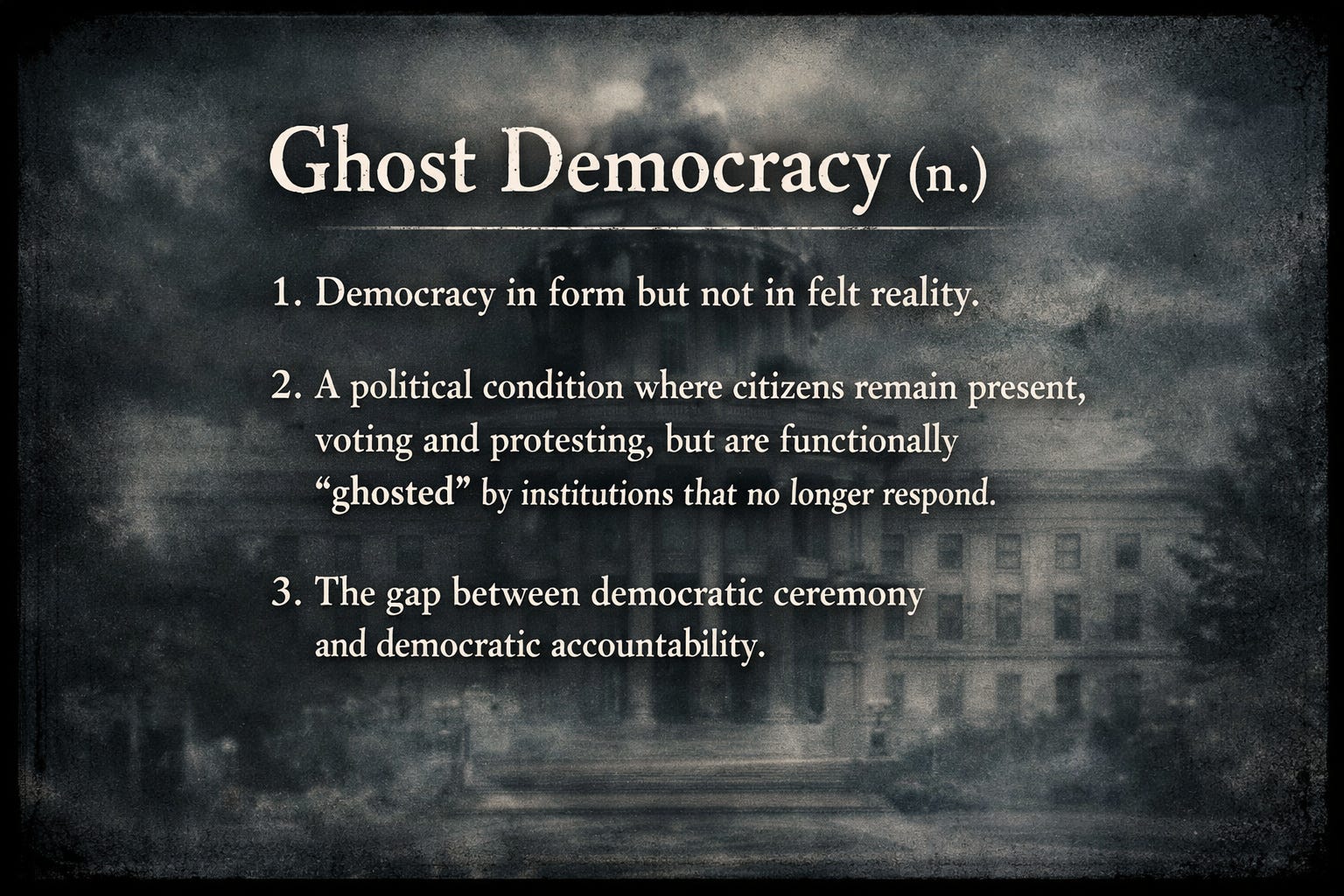
You want to believe that if you just speak clearly enough—if you just bring enough evidence—if you just show enough people—if you just shine enough light—someone will blink and say, “Oh. Right. We can’t do that. We have to stop.”
But the blinking never comes.
Because this isn’t a misunderstanding. It’s a strategy.
And then people say the fantasy sentence: “Just move.”
As if you can step out of a province the way you step out of a room.
As if your life isn’t built in layers: homes, jobs, family, friends, community, history. As if it’s not a demolition to uproot it. As if you don’t have elders who need you. Kids with stability you can’t casually smash. Work you can’t magically replicate somewhere else. A mortgage. A network. A life you built with years of ordinary effort.
“Just move” is what people say when they want an easy ending to a story that doesn’t have one.
So you remain.
Not because it’s fine.
Because leaving isn’t simple.
And because even if you could leave—where do you go, exactly? How do you walk away from a place you love as it becomes something you don’t recognize? How do you abandon the soil you’re rooted in without also abandoning yourself?
So you stay. Some people stay silent, watching and hating what they see, but not speaking up because it isn’t safe. They know they will be a target. They know it might cost them their job. They know it might land on their family like a stone. They know that in a province where anger is being farmed like a crop, the wrong sentence can make you the day’s meal.
People on the outside call that cowardice.
People on the inside recognize it as survival.
Others speak out anyway.
And they learn a new kind of exhaustion: the kind that comes from shouting into a machine designed to convert your voice into noise. Their voices drown in hate. In coordinated outrage. In accounts that don’t even sound like people. The same phrases. The same cadence. The same heat. The same certainty. The same swarm arriving on command.
Call it bots. Call it campaigns. Call it influence. Call it “the algorithm.” Call it a few power users working overtime. Call it whatever makes you feel less crazy.
The effect is the same: exhaustion as a weapon.
It isn’t only what they say. It’s the point of it. The goal isn’t to win an argument. The goal is to make you tired. To make you hesitate. To make you wonder if you’re alone. To make you second-guess your own eyes. To make you choose quiet because quiet is safer than being surrounded.
And it works.
Because you can’t live at a constant scream.
You protest. And those in power laugh and sneer from their windows high above you because they know what happens next: the protest ends. People go home. People return to work. People have to feed their kids and pay their rent and make the next appointment and shovel their driveways and keep their lives from falling apart.
And then the powerful do what the powerful do: they wait you out.
Democracy becomes a ritual where you are allowed to perform your anger in designated areas and then disappear again. A controlled burn. A pressure valve. Something the system can tolerate because it doesn’t change the system.
You petition, and petitions become props of political theatre: great care, time, and attention poured into creating them, signatures collected with hope like it’s currency, and then their brief life on stage… before they are stuffed into vaults for storage, never to be seen again.
That’s what helplessness is made of.
Not apathy. Not ignorance. Not people who “didn’t care.”
It’s made of people who care so much they can’t sleep—and who still wake up to a government that behaves like caring is irrelevant.
And then there’s the part that should make you feel sick: we pay for it.
We pay for the reality they want us to see.
Our own money is used by those in power to manufacture reality… a cover story. Manipulated surveys. Carefully monitored results. Numbers that can be caressed in back rooms until they resemble what power wants.
And even if you don’t believe the caressing happens—here’s the darker truth: it doesn’t have to.
Because they only have to tell us what the results were, and never show the reality. They only have to announce their version of public opinion, repeat it until it hardens, and dare anyone to prove otherwise while they control the megaphones.
And while that’s happening, they take cattle prods to the angriest and most hateful among us. They prod and prod and prod, not because they want those people to be satisfied, but because they want them activated. They want them loud. They want them weaponized. They want them useful.
They want division that can be pointed at later as justification.
Look, they’ll say. Look at the anger. Look at the threat. Look at the chaos.
And the people they’ve been prodding will justify the government’s draconian and equally hateful actions, because hate always believes it’s defending itself.
This is how a place becomes unrecognizable without a single dramatic collapse. Not with one coup. With a thousand normalizations. A thousand moments where power learns it can ignore you, punish you, mock you, manufacture reality, and still be rewarded.
And then—inevitably—someone outside looks in and asks the question again: Why didn’t you stop it?
That question is the luxury of distance.
Because stopping it isn’t a slogan. It’s not a viral post. It’s not a march with a neat ending. Stopping it is the long, grinding work of trying to hold onto rights while the people in power treat rights like an inconvenience. It’s trying to be brave while also keeping your family safe. It’s trying to fight while also paying bills. It’s trying to stay human while being told you’re not worth listening to.
Albertans are Americans now.
Not 51st state Americans.
Failed-state-feeling Americans.
People watching the province they love fall, learning empathy the hard way: not by reading about helplessness, but by living inside it.
And if you want a reason to write about this—if you want a reason to say it out loud, even when it feels useless—it’s this:
Because the machine feeds on isolation. It feeds on exhaustion. It feeds on silence. It feeds on the idea that you are alone and no one else sees what you see.
So say it anyway.
Not because you think one post will fix it.
Because naming the reality is how people find each other in the dark.
Because the opposite of helplessness isn’t a hero.
It’s a we.
It’s people refusing to be turned into ghosts.